




1 Introduction
Although critics of hegemonic models of science are not new, the academic interest in decolonial discourses has increased in recent years. If science was once defined as an objective and universal practice, decolonial scholars have challenged this assumption, emphasizing that science, as any other human endeavor, is traversed by the cultural and sociological contexts where it is developed. Historians of science have shown that knowledge has tended to be concentrated in a few places whose theories and methods have been spread to all other countries and regions. To reverse this tendency, both the material and symbolic dimensions of the concentration processes have to be addressed. Rodríguez-Medina (2014) distinguishes decentring, which challenges the symbolic dimension of the concentration of power and resources, from decentralizing, which addresses its material dimension. He argues then that the decolonization of ideas -i.e. decentring- needs a corresponding epistemic decentralization that creates the material conditions for peripheries to challenge mainstream discourses.
Although it also has effects in other areas of the scientific knowledge production process, one of the most striking examples of the concentration of symbolic and material resources is the academic publishing system. Focusing on the material dimension, this means that most publishers, journals, and articles are concentrated in the Global North, especially in the United States and Europe -for a theoretical argumentation see Alatas (2003), or that English has become the lingua franca of the academic world (Canagarajah, 1996; Lillis & Curry, 2010). This concentration is also reflected in the location and journals indexed in international journal indexing systems -namely, Web of Science (WoS) and Scopus- which are the main sources of data for scientific evaluation, including research and funding assessments, and bibliometric analyses worldwide. However, although largely acknowledged as the only authorities in the identification of high-quality research, the status of WoS and Scopus is currently being challenged due to their various biases, including limitations in their coverage of research disciplines (Archambault et al., 2006; Larivière & Macaluso, 2011; Larivière et al., 2015), geographical regions (Asubiaro et al., 2024; Chavarro et al., 2018), and languages (Lillis & Curry, 2010; Mongeon & Paul-Hus, 2016; van Leeuwen et al., 2001; Vera-Baceta et al., 2019).
The need for more inclusive and comprehensive bibliographic data sources is especially pressing in areas that have historically been marginalized in these traditional systems. Several studies have shown that Scopus and WoS fail to provide an accurate picture of global scholarly publishing (Khanna et al., 2022), with the Global South, particularly Africa, being the most affected. For example, analysis of WoS data by Tijssen (2007) revealed that African authors contributed fewer than 1.5% of indexed publications between 1980 and 2004. More recent research by Asubiaro et al. (2024) found that journals from sub-Saharan Africa were the least represented in both Scopus and WoS. In an earlier study, Asubiaro and Onaolapo (2023) not only confirmed this limited representation, but also emphasized the potential of alternative databases like Crossref to address these gaps. Other studies have highlighted the potential of alternative source types, such as academic networks, to study publication and collaboration patterns in sub-Saharan Africa (Harsh et al., 2021). Scholars have also highlighted the importance of using field-specific or national citation indexes -over multidisciplinary and international databases- for certain types of analyses (Mongeon & Paul-Hus, 2016). This recognition aligns with broader efforts reflected in the development of alternative journal indexing systems and repositories, which aim to mitigate coverage biases and promote the international recognition of regional and local research.
One of the first examples of regional journal repositories is African Journals Online (AJOL), which was launched in 1998 by the International Network for the Availability of Scientific Publications (INASP) in collaboration with the Public Knowledge Project (PKP). When it was initiated, AJOL only covered 50 African journals. In March 2024, the number of covered journals increased to 739 from 39 African countries. However, despite its extensive coverage, the AJOL remains an understudied source of bibliometric data from African countries. One of the reasons for its absence from bibliometric studies is the difficulty of accessing AJOL’s data. As AJOL is not a full-fledged academic database, it does not provide metadata for its articles, and it does not have an advanced search tool that allows users to build search strategies. The website is, therefore, a journal directory that allows users to browse journals’ issues and volumes but prevents them from searching for specific articles or topics. In terms of bibliometric analysis, AJOL does not curate nor provide access to metadata from journals or articles. However, some metadata fields are available in AJOL’s website and can be retrieved manually or using web scrapping techniques.
Recent literature has also pointed out to the potential of AJOL as a data source of bibliographic data for the African continent. Alonso-Álvarez (2024) showed that AJOL can counteract the biases in mainstream databases towards African science. However, the data source also presents its limitations, especially in terms of regions and languages, presenting missing countries and important imbalances between countries, and mostly publications written in English. Despite these limitations, this article regards AJOL as a valuable source of information on African journals and publications and seeks to facilitate its accessibility and usability. Accordingly, the main objective of this paper is to present a publication and journal database derived from AJOL content, designed to support its use as a bibliometric data source for the study of African scholarly production. The database introduced herein provides researchers and other users with a structured, downloadable version of AJOL data that can be readily explored and analyzed. The paper also presents a comprehensive picture of AJOL data regarding journals and academic papers and provides information about the limitations of the data. The database aims to contribute to the idea of a decentralized and federated system of sources (e.g. Babini et al., 2024). Therefore, to facilitate the interoperability of AJOL articles’ data with other academic databases, the database also includes a table that matches AJOL and OpenAlex documents using the unique identifiers of each data source. The matching AJOL-OpenAlex aims to contribute towards the idea of a federation of open research information sources.
2 Data and methods
2.1 Data collection
The journal list and publications indexed in AJOL were retrieved using web scraping techniques. The metadata of the publications were retrieved using the R package ojsr (Becerra, 2024), which scrapes the metadata of the articles indexed in Open Journal Systems (OJS) pages from their head tag in html. For the journals’ information, the data were downloaded from various pages of AJOL’s website using the rvest R package (Wickham et al., 2024). Both publications’ and journals’ metadata were retrieved in February 2024.
2.1.1 Journal metadata
Information was retrieved from 739 journals using the rvest package. The metadata fields were merged together using journal titles and urls. A unique identificatory was created for each journal to join them with the publications database.
As AJOL does not provide the metadata by journal, it was retrieved from different pages within the website. This process led to some incongruencies in journal coverage. For instance, a journal may appear in the country classification but not in the research area classification. Journals that did not appear in one of the classifications were assigned NAs (Not Available information) for that field. In the case of the open access field, AJOL only reports the journals that have diamond access. The rest of the journals were classified as non-diamond.
The ISSNs were retrieved from each journal’s AJOL site using web scraping. Eleven journals were missing both print ISSN and eISSN. Of these, three were found in the ISSN Portal, and their ISSN fields were manually added. All retrieved ISSNs were cross-checked against the ISSN Portal and were recognized by it, although some were at different stages of the validation process (e.g. awaiting validation).
As a way to increase the credibility of the journals it indexes, AJOL employs the Journal Publishing Practices and Standards (JPPS) framework, developed conjunctly by AJOL and the International Network for Advancing Science and Policy (INASP). The JPPS classifies journals into six categories depending on the JPPS criteria they meet: inactive title, no stars, new title, one star, two stars, and three stars. All criteria were retrieved from the JPPS website ① . New title, one star, two stars, and three stars work hierarchically, in which a higher category includes all criteria from the previous one and other additional requirements. Finally, the inactive category includes journals that are not up to date in the Journals Online System (JOL). It is worth noting that journals that do not meet the JPPS criteria to belong to one of the higher levels can still appear in AJOL under the no-stars category.
Table 1 shows the number and percentage of NAs per metadata field and the final population of journal metadata fields in the database (Final N).
Table 1. Population of journal metadata fields. |
| Field | NAs | % NAs | Final N |
|---|---|---|---|
| Title | 0 | 0 | 739 |
| eISSN | 84 | 11.4 | 655 |
| ISSN print | 334 | 45.2 | 405 |
| country | 0 | 0 | 739 |
| JPPS status | 5 | 0.7 | 734 |
| OA | 0 | 0 | 739 |
| Research area | 3 | 0.4 | 736 |
2.1.2 Publications metadata
In total, metadata fields from 237,263 articles were downloaded. Finally, only 223,981 articles were kept after removing publications with no metadata and duplicates. Regarding metadata, 11,767 publications had missing values (NAs) in almost every metadata field, including the title, DOI, and journal. In some cases, data from 11,767 articles with missing values appeared at the front end of the AJOL page. However, it has not been recorded in the HTML tag; therefore, it is not included in the database. After removing publications with no metadata, 1,515 duplicated records were found and removed from the database.
The quality of the data was assessed to spot errors and clean the data. In the cases where erroneous data could be identified following an aggregate process -for instance, erroneous format (e.g. alphabetical values in pages field), non-reported missing values (e.g. instances of “abstract” being the content of the field abstract, or “keywords” being the content of the keywords field), etc. - invalid data was removed. The process and all modifications are reported in the read me file of the database, along with the manual checks made in all fields.
Table 2 presents all the fields in the articles’ head tags, the missing observations for each field, and the final population (Final N column) of the fields included in the database after removing NAs, duplicates, and erroneous data, as described in the paragraph above. In the case of repeated fields (ex. DC.Identifier.DOI and citation_doi), only one of them was selected as the content was identical.
Table 2. Population of publication metadata fields. |
| Field | NAs | % NAs | Selected | Final N |
|---|---|---|---|---|
| input_url | 0 | 0 | 1 | 223,981 |
| DC.Creator.PersonalName | 11,866 | 5.00 | 0 | - |
| DC.Date.created | 76,341 | 32.18 | 0 | - |
| DC.Date.dateSubmitted | 11,767 | 4.96 | 0 | - |
| DC.Date.issued | 11,872 | 5.00 | 1 | 223,876 |
| DC.Date.modified | 11,767 | 4.96 | 0 | - |
| DC.Description | 11,770 | 4.96 | 1 | 192,933 |
| DC.Format | 17,566 | 7.40 | 0 | - |
| DC.Identifier | 11,767 | 4.96 | 1 | 223,981 |
| DC.Identifier.pageNumber | 69,133 | 29.14 | 0 | - |
| DC.Identifier.URI | 11,767 | 4.96 | 0 | - |
| DC.Language | 11,767 | 4.96 | 0 | - |
| DC.Rights | 11,767 | 4.96 | 0 | - |
| DC.Source | 11,767 | 4.96 | 1 | 223,981 |
| DC.Source.ISSN | 13,498 | 5.70 | 0 | - |
| DC.Source.Issue | 28,964 | 12.21 | 1 | 206,866 |
| DC.Source.Volume | 12,298 | 5.18 | 1 | 223,450 |
| DC.Source.URI | 11,767 | 4.96 | 0 | - |
| DC.Title | 11,767 | 4.96 | 1 | 223,981 |
| DC.Type | 11,767 | 4.96 | 0 | - |
| DC.Type.articleType | 11,767 | 4.96 | 0 | - |
| gs_meta_revision | 11,767 | 4.96 | 0 | - |
| citation_journal_title | 11,767 | 4.96 | 0 | - |
| citation_journal_abbrev | 11,767 | 4.96 | 0 | - |
| citation_issn | 13,498 | 5.70 | 0 | - |
| citation_author | 11,767 | 4.97 | 0 | - |
| citation_title | 11,785 | 4.96 | 0 | - |
| citation_language | 11,767 | 4.96 | 0 | - |
| citation_date | 11,767 | 4.96 | 0 | - |
| citation_volume | 12,298 | 45.18 | 0 | - |
| citation_issue | 28,964 | 12.21 | 0 | - |
| citation_firstpage | 69,177 | 29.14 | 1 | 166,217 |
| citation_lastpage | 69,137 | 29.16 | 1 | 166,056 |
| citation_abstract_html_url | 11,767 | 4.96 | 0 | - |
| citation_pdf_url | 18,314 | 7.72 | 0 | - |
| DC.Subject | 114,973 | 48.46 | 1 | 121,399 |
| citation_keywords | 114,973 | 48.46 | 0 | - |
| DC.Identifier.DOI | 137,180 | 57.82 | 1 | 99,073 |
| citation_doi | 137,180 | 57.82 | 0 | - |
| citation_author_institution | 212,079 | 89.40 | 0 | - |
| DC.Coverage | 237,263 | 100 | 0 | - |
| citation_reference | 237,232 | 99.99 | 0 | - |
| DC.Title.Alternative | 237,263 | 100 | 0 | - |
Language and type were not added to the table due to the high number of errors found in the metadata.
Multiparty fields, such as keywords and authors, were split and recorded in new tables.
All source fields were removed. To link the publications table with the journal’s table, an identifier was created. To link the articles’ table with the journals’ table, the common sections of the URLs of the articles and journal pages were used. Then, journal identifiers were created and added to the articles’ table.
2.2 Matching with OpenAlex
Articles were matched against the OpenAlex (Priem et al., 2022) data dump using journal names, DOIs, and other article metadata. The process was conducted in several steps, prioritizing accuracy at each stage. Rather than maximizing the number of matches, the approach focused on ensuring accuracy. After each step, checks were performed to remove any duplicate rows from the resulting table. Matched articles were removed from the initial AJOL table so that the remaining steps were applied only to non-matched articles. In cases of duplicate matches, duplicates were removed from the matched article table and added back to the non-matched table for inclusion in the subsequent steps.
• Exact match by DOI: A total of 80,667 matches were identified.
• Exact match by journal and title: 67,191 matches were found after excluding common titles (e.g. “introduction”, “review”) to avoid false positives.
• Exact match by journal and fuzzy title match: 7,265 matches were identified. To account for inconsistencies between the databases, all titles were transformed to lowercase, and punctuation was removed. A Levenshtein distance threshold of less than 20 characters and a distance-to-title length proportion of less than 0.25 were applied to minimize errors. A sample of 100 matches was manually verified, and no errors were detected.
• Exact match by journal, year, issue, volume, and pages: 435 matches were identified in this step. Since the pages field can be inconsistent in both OpenAlex and AJOL, this step was performed last to reduce potential errors. All matches were manually checked, and 10 erroneous matches were removed.
In total, 155,558 articles were successfully matched out of 223,981 articles in AJOL. This aligns with recent studies on OpenAlex coverage. For example, Chavarro and Alperín (2024) reported that OpenAlex covers 70% of journals using the Open Journal System (OJS). Since AJOL does not record some metadata fields, matching AJOL with OpenAlex provides additional insights into the data, such as affiliation and institution analysis or collaboration patterns at different levels.
However, several important limitations related to the matching process must be acknowledged. The following three figures illustrate the percentage of articles indexed in OpenAlex based on the matching procedure described above, disaggregated by year, research field, and country. Figure 1 reveals that the coverage rates for articles published before 1995 are significantly lower than those published thereafter. It is important to contextualize this finding by noting that the volume of publications in AJOL prior to 1995 is itself quite limited, typically ranging from 20 to 40 articles per year, with a few exceptions; for instance, AJOL recorded 83, 80, and 103 publications in 1987, 1988, and 1991, respectively. The number of indexed publications began to increase in 1997 (198 publications), exceeded 1,000 in the year 2000, and consistently ranged between 10,000 and 15,000 annually from 2010 onward.
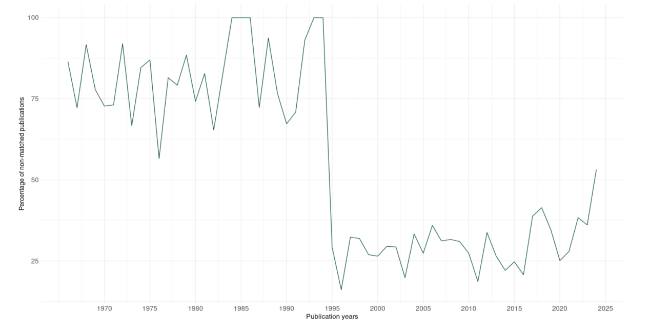
Figure 1. Percentage of publications not matched in OpenAlex by year. |
Figure 2 presents the proportion of non-matched publications by research area, bearing in mind that journals, and consequently their articles, can be assigned to up to three subject areas in the AJOL. The figure indicates that certain fields, such as History and Communication and Library Science, exhibit relatively low coverage in OpenAlex, with over 50% of their publications not indexed. However, most research areas show coverage rates between 60% and 80%. Religion is the only field with a coverage rate exceeding 80%, and only 15% of its publications are not included in OpenAlex.
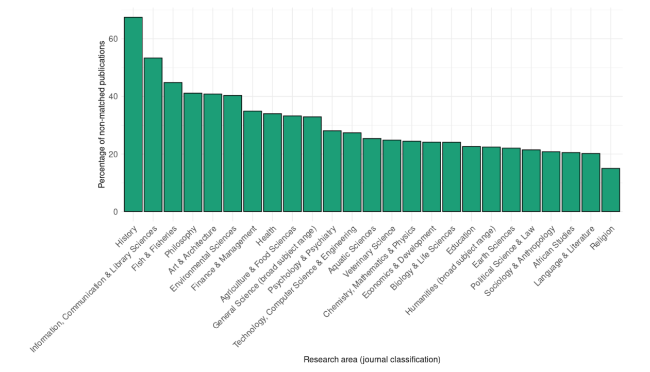
Figure 2. Percentage of publications not matched in OpenAlex by research area (AJOL journal classification). |
Regarding countries, Figure 3 shows that those with the highest number of journals indexed in AJOL—namely Nigeria and South Africa, with 78,918 and 60,091 publications, respectively, compared to 21,904 from the next most productive country, Kenya—also exhibit the lowest levels of coverage in OpenAlex. In contrast, the percentage of unmatched publications for all other countries remained below 5%.
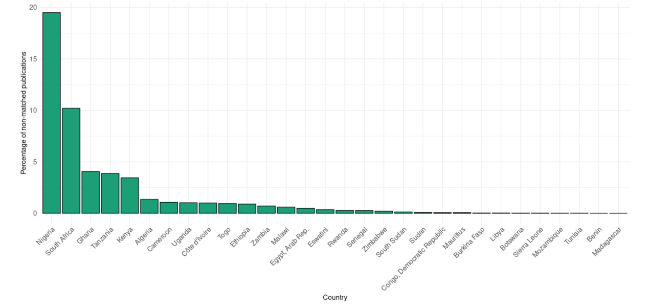
Figure 3. Percentage of publications not matched in OpenAlex by journal country. |
2.3 Data structure
The final database was divided into six tables, linking publications, journals, and related metadata. Figure 4 shows the database diagram, Table pub stores publication-level information, including DOIs, titles, and bibliographic data, and connects to supporting tables for abstracts, keywords, authors, and external identifiers (e.g. OpenAlex). The source table contains journal-level metadata, such as ISSNs, country, and quality classification (e.g. JPPS status), while the source_area table associates journals with research areas.
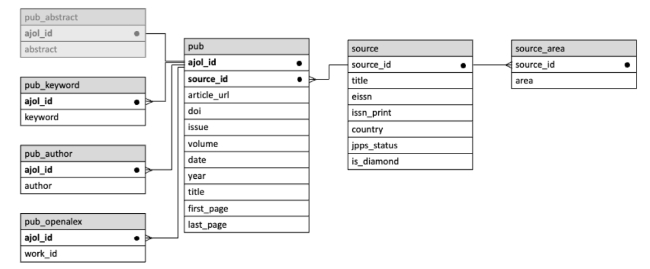
Figure 4. Database diagram. ② |
3 Results
This section presents the descriptive statistics of the selected fields of the database.
3.1 Journals
Figure 5 shows the distribution of journals across African countries, with each country shaded based on the total number of journals hosted. The color scale on the right indicates the number of journals per country, ranging from light green (low journal count) to dark green (high journal count).
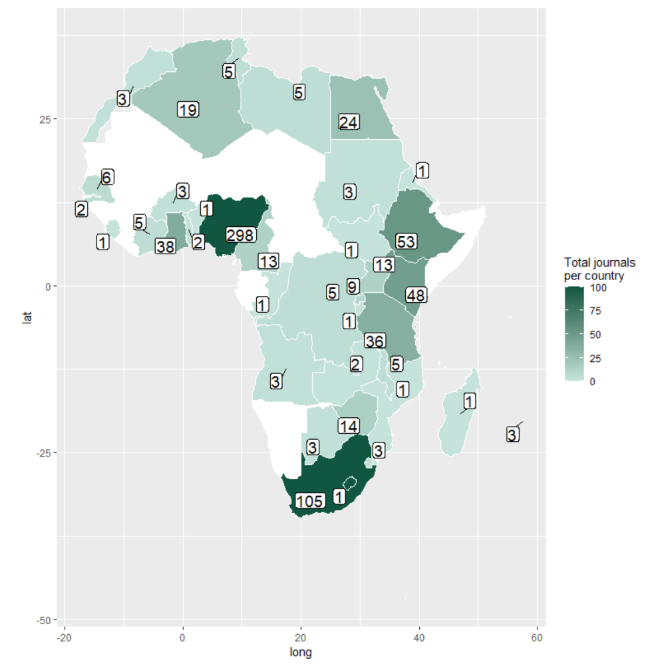
Figure 5. Number of journals by country. |
The countries with the highest numbers of journals are Nigeria (298 journals) and South Africa (105 journals). Other countries with relatively high numbers of journals include Ethiopia (53 journals), Kenya (48 journals), Ghana (38 journals), and Tanzania (36 journals). In contrast, many countries, especially in Central and Northern Africa, are home to only a few journals. For example, countries like Libya, Botswana, and Namibia host only one to three journals. Some countries show moderate levels of academic journals, with countries such as Algeria (19 journals), Zimbabwe (14 journals), and Cameroon and Uganda (13 journals) occupying the middle range. Countries such as Chad, Central African Republic, Guinea, Guinea-Bissau, Liberia, Mauritania, Mali, Namibia, Niger, Somalia, and Western Sahara do not appear on the map, as they do not have any journals indexed in AJOL.
This map highlights significant disparities in the distribution of academic journals across Africa, with a concentration of journals in only a few countries. While countries like Nigeria and South Africa are major hubs for academic publishing, many other African nations have very limited journal output, or none at all, which reflects the disparities between countries, even in a specialized source.
Figure 6 shows the distribution of journals across the JPPS quality categories and types of access. The graph on the left highlights the concentration of journals in the 1 Star, 2 Stars, and No Stars categories. This suggests that while many journals meet basic standards, fewer journals reach the highest thresholds (3 Stars), and a significant portion of journals either fail to meet star rating criteria or are inactive.
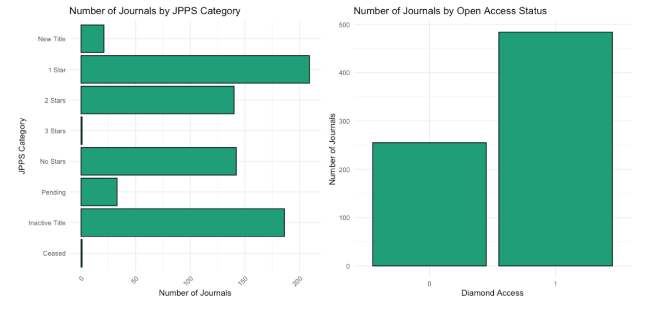
Figure 6. Number of journals by JPPS category (left) and number of journals by access type (right). |
The substantial number of Inactive Titles suggests that there are numerous journals that have ceased publishing but are still considered part of the AJOL, which highlights the role of the platform as an archive of African journals to improve its access and visibility regardless of them being active or not, differentiating it from traditional indexes, whose main objective is to index and rank active journals.
The graph on the right side of the Figure shows a higher number of diamond access journals than journals with other access types. This distribution is in line with the AJOL policy of supporting open access and free-fee publication models.
3.2 Publications
Figure 7 presents the total number of publications by year (green bars) and the relative share of publications with Digital Object Identifiers (DOI) (orange line) over time. From the 1990s onward, there is a significant increase in publications, reaching a peak between 2010 and 2020. The apparent decrease in 2024 is attributed to the data collection date, February 2024, meaning that publications released after this point were not yet included in the dataset.
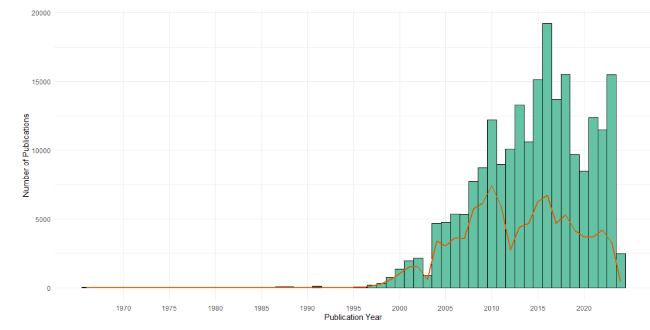
Figure 7. Publications (bar plot) and publications with DOI (orange line) by publication year. |
The number of publications with DOIs follows a similar pattern to total publications, indicating the increasing adoption of DOIs as a standard identifier in scholarly publishing. This line remains aligned with the overall trend after 2000, suggesting that a significant proportion of publications have since been assigned DOIs. However, despite the growth in publications continues until 2015, there is a slight decline in the number of DOIs. To better assess the causes of this decline, the metadata in AJOL were compared with the metadata available in OpenAlex, which revealed that the drop was a cause of changes in AJOL’s reporting practices rather than a decline in the adoption of DOIs.
Figure 8 presents the distribution of publications across different research areas, illustrating the total number of publications per area. In AJOL, research areas are assigned at the journal level, meaning that the research areas of the publications correspond to the fields of the journals. As the publications’ areas depend on the journals’ classification, they are both plot together for comparison. The x-axis lists the research areas, while the y-axis represents the number of journals (green bars) of publications (orange line).
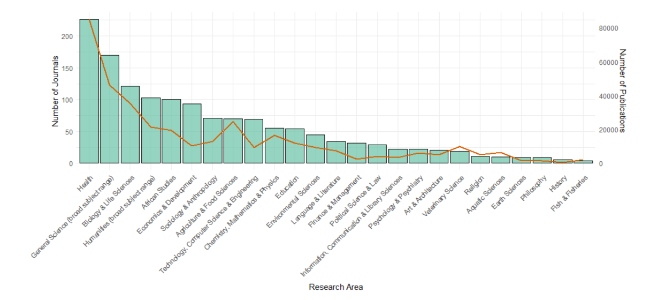


Figure 8. Publications and journals by research area (journal area classification). |
Health dominates the distribution, with over 80,000 publications and 200 journals, making it by far the largest field in terms of output. Following Health, Biology and Life Sciences, and Agriculture and Food Sciences also have significant publication numbers, though at considerably lower levels than health, each with between 30,000 and 40,000 publications. In the case of journals, Biology and Life Sciences and Humanities present the highest numbers after Health, followed by African Studies and Economics and Development. In both publications and journals, History, Philosophy, and Earth Sciences have the lowest representation, with fewer than 1,000 publications each.
The relationship between the number of journals and the number of publications is generally proportional, although fields like Agriculture & Food Science or Veterinary Science show higher publication output compared to their journal count. Other fields like Finance & Management, show a lower publication output than the number of journals. Differences in the trends of journals and publications might be due to the different publication patterns between journals. For instance, some journals in AJOL publish only one issue per year, while others publish one every few months. The number of papers per issue can also influence the relationship between the number of journals and papers.
Table 3 shows the number of publications in the AJOL according to the authors’ country. For this analysis, the matching between OpenAlex and AJOL was used and then merged with the OpenAlex data dump. Author country data were found for 94,168 publications. No normalization was applied for articles with more than one author. The two most productive countries are Nigeria (25,902) and South Africa (24,755), followed by three non-African countries: the United States (5,528), China (3,919), and India (3,615). In Africa, other countries with high productivity are Ethiopia (3,132), Ghana (2,723), Kenya (2,461), Tanzania (1,970), Morocco (1,637), Egypt (1,479), Uganda (1,410), Cameroon (1,307), Benin (1,258), Ivory Coast (1,249), and Zimbabwe (1,225). The rest of the continent, particularly the Central and Sahel regions, show lower publication outputs. Outside Africa, some countries in. Europe and the Middle East show high publication outputs, while South America and the Southeast of Asia present lower values ③ .
Table 3. Top 10 countries by number of publications in AJOL. |
| Country | # pubs |
|---|---|
| Nigeria | 25,902 |
| South Africa | 24,755 |
| United States | 5,528 |
| China | 3,919 |
| India | 3,615 |
| Ethiopia | 3,132 |
| United Kingdom | 2,899 |
| Ghana | 2,723 |
| Kenya | 2,461 |
| Tanzania | 1,970 |
The results highlight that African journals serve as international venues, attracting contributions from authors both within and outside the African continent. This global authorship pattern demonstrates the broad appeal and relevance of African-based journals in disseminating research across a variety of regions. Many authors from countries in the Global North, including the United States, the United Kingdom, and parts of Europe, contribute to African journals, suggesting that these journals are not only regionally focused but also engaged in the global exchange of knowledge.
4 Conclusions
This study highlights the potential of AJOL as a valuable bibliometric source for understanding African academic publishing. By systematically retrieving and structuring AJOL’s data, this paper provides researchers with a more accessible and usable version of its metadata, filling a significant gap in bibliometric research focused on the African continent. It is worth mentioning that, while AJOL contains relevant information for identifying and providing insights about African publications and journals, its metadata is limited. This is, however, expected, as AJOL is not an academic database, but a journal repository designed to give visibility to African journals. Therefore, this study relies on web scraping techniques to retrieve the available metadata and construct an accessible database.
The database introduced in this article contributes to the accessibility of African scholarly publications by providing structured, accessible metadata derived from the AJOL. It facilitates bibliometric analyses that are more representative of African research activities. This contribution complements ongoing efforts to develop alternative data sources and infrastructure that better reflect the diversity of global knowledge production, including those based on national repositories, regional indexes, and open metadata platforms. Moreover, by leveraging OpenAlex’s additional metadata, this study demonstrates that metadata gaps can be partially addressed, enabling more detailed analyses of African research outputs. By doing so, it aims to contribute to the scientific decentralisation stated by Rodriguez Medina (2024) and offers a new tool for bibliometric analysis that might help mitigate coverage biases in bibliometric analysis of African scientific production.
The analysis of journals indexed in AJOL revealed significant disparities in their distribution across African countries. Nigeria and South Africa have emerged as major hubs. This uneven distribution highlights the concentration of publishing resources in a few key countries, reflecting broader disparities in the African academic publishing landscape. This also shows that further efforts are needed to expand the coverage of AJOL to the most underrepresented countries. Furthermore, the analysis of journal quality categories using the JPPS framework shows that most journals fall into the 1 Star, 2 Stars, or No Stars categories, with relatively few reaching the highest (3 Stars) standards. The substantial number of Inactive Titles also underscores AJOL’s role as an archival platform, distinguishing it from traditional indexing systems focused solely on active journals. The publication analysis demonstrates a steady growth in the number of publications over time. The analysis also highlights the increasing adoption of Digital Object Identifiers (DOIs), aligning with global trends in scholarly publishing. Biases towards Health Sciences, Biology and Life Sciences are also observed in the analysis, while fields like Philosophy, History, and Earth Sciences remain underrepresented.
Finally, the inclusion of matched data with OpenAlex further enhances the utility of the database. This paper presents an example of the possibility of integrating both sources using author country data from OpenAlex. The analysis of author contributions reveals that African journals serve as both regional and international venues. Further analysis might explore other areas like collaboration patterns, institutional affiliations, and citation networks, which cannot be addressed only with AJOL data. The ability to integrate AJOL with global databases demonstrates its capacity to contribute to a more inclusive and comprehensive representation of global science.
These findings confirm that African journals play a dual role in fostering both regional and global research engagement. As shown in Table 3 of author contributions, African journals attract submissions from both African-based and international researchers. This underscores their importance as venues for disseminating locally relevant research while also participating in the global exchange of knowledge. However, the article also shows the important limitations of such data sources, both in terms of coverage and metadata, highlighting the importance of initiatives and efforts that address these issues and help provide a more comprehensive picture of African science. Finally, while this study reinforces AJOL’s role in amplifying the visibility of African journals, it also raises broader questions about the role of such regional platforms in the global bibliometric ecosystem. Platforms like AJOL not only document African research but also serve as a counterbalance to the regional, linguistic, and disciplinary biases inherent in traditional data sources. However, their long-term impact will depend on continued investment in their development, stronger interoperability with global data infrastructure, and increased engagement from the scientific community to ensure that their data are both comprehensive and widely used.
Acknowledgements
The author would like to thank the valuable comments and suggestions of two anonymous reviewers, which have helped me to improve the quality of the manuscript.
Data availability statements
The database containing AJOL data is deposited in Zenodo: 10.5281/zenodo.15383374
Funding information
This work was supported by a PIPF contract of the Madrid Education, Science and Universities Office (grant number: PIPF-2022/PH-HUM-25403).