




1 Introduction
Achieving a prestigious scientific award or being elected a fellow of an international scientific society are symbols of scientific recognition and academic prominence in modern science (Zuckerman, 1977). Usually, such honors are the breakthroughs of years, often decades, of dedicated research and significant contributions to a field. For instance, a discovery worthy of a Nobel Prize, on average, waits more than 20 years to be recognized (Fortunato, 2014). Similarly, in computer sciences, the journey to the Turing Award may span up to 40 years after the scientist’s first publication (Jin et al., 2021). Yet, there are remarkable cases where scientists achieve systematic and rapid recognition, such as James Watson receiving the Nobel Prize at age 34 for DNA structure discovery, or Donald Knuth winning the Turing Award at 36 for his contributions to computer programming. Understanding these recognition dynamics is crucial because prestigious awards significantly influence career trajectories and funding opportunities, and systematic patterns in differential recognition timing may reveal evaluation biases that affect scientific equity (Zhu et al., 2023). This raises the question: what contributes to variation in recognition timing among scientists with similar career stages?
Research on factors associated with scientific recognition timing has evolved from early focus on individual characteristics to increasingly sophisticated understanding of social mechanisms. Initial studies established that institutional prestige, nominator status, and endorsements from established scientists significantly influence recognition speed (Chen et al., 2023; Li & Tang, 2019; Ma et al., 2020; Xie, 2017; Yang et al., 2015). Zuckerman’s seminal work demonstrated that university prestige and mentors’ prizewinning status alter the age at which Nobel laureates receive recognition (Zuckerman, 1977). Recent advances have expanded this understanding to examine collaboration networks, with studies showing that co-authorship with established fellows, strategic collaboration patterns, and academic lineage significantly shape recognition trajectories in ACM fellows and Nobel laureates (Jiang & Liu, 2018; Ma & Uzzi, 2018; Tol, 2024; Zhou et al., 2023). However, critical gaps remain: existing research largely provides cross-sectional analyses without examining how collaboration dynamics evolve over time, lacks systematic investigation of different collaboration characteristics (frequency, recency, collaborator prestige) on recognition speed, and has not comprehensively analyzed the interaction between social factors and collaboration networks across extended periods. To systematically investigate the role of collaboration networks in Association for Computing Machinery (ACM) fellowship recognition, we address three primary research questions:
RQ1: How has collaboration with ACM fellows among new electees changed over time?
RQ2: What is the relationship between fellow collaboration and time to fellowship?
RQ3: How do collaboration characteristics (frequency, recency, prestige) affect this relationship?
Here, we investigated the interval between graduation and fellow election of nearly all fellows of the ACM elected between 1994 and 2023 (1,497 of 1,512, representing 99%). As the world’s largest computing society, the ACM recognizes only the top 1% of members as fellows each year since 1994, for their outstanding accomplishments in computing and information technology and/or exceptional service to ACM and the broader computing community (see https://awards.acm.org/fellows). Election as a fellow requires endorsement from at least five ACM professional members, with ACM guidelines noting that “It is strongly recommended, but not required, that they be ACM fellows” (see https://awards.acm.org/fellows/faq). By examining the ACM fellows’ time interval from graduation to fellowship and their co-authorship patterns with ACM fellows, we found that collaborating with ACM fellows can significantly fast-track new electees’ careers to ACM fellowships.
We collected data on ACM fellows’ election and highest degree years, publication records from Scopus, co-authorships, and overlaps in research fields, PhD institutions, and workplaces. Using linear regression, we analyzed how different collaboration types, while controlling for publications, citations, and collaborators, influence the time to ACM fellowship. We included social factors such as gender, work and PhD affiliation overlaps, and subfield overlaps to understand determinants affecting the time to achieve ACM fellowship (see Supplementary Materials Supporting Information Text for more details).
2 Results
2.1 Collaborative pathways to ACM fellowship
Our analysis showed an increasing rate of new electees who have collaborated with existing ones. In 1995, the second election year of ACM fellowship, about 43% of electees had a record of co-authorship with ACM fellows, and this rate has rapidly increased to more than 90% after two decades, even reaching 100% in 2016 (Fig. 1A). More specifically, we observed significant disparities in gender, alma mater, and country of birth among the electees throughout the years. Only 207 women (13.8%), 300 born in Global South countries (20.0%), and 334 graduates from non-American universities (22.3%) have been elected since 1994. Moreover, all these groups showed an increasing tendency to collaborate with ACM fellows. As Fig. 1B demonstrates, by comparing the average years from graduation to ACM fellowship between two groups, we found that, on average, electees who had collaborated with ACM fellows achieved fellowship 3.80 years earlier than those who had not (23.79 years vs. 27.59 years). This gap has rapidly widened over the last decade, from around 4 years in the first two decades since 1994, to 5.05 years (24.75 years vs. 29.80 years) in the latest decade. These findings suggest a critical mechanism of talent promotion within the ACM community, where established authorities not only recognize but actively foster the emergence of promising talents through collaboration. Such endorsements significantly enhance the visibility and perceived credibility of emerging scientists, positioning them favorably for prestigious honors and recognitions.
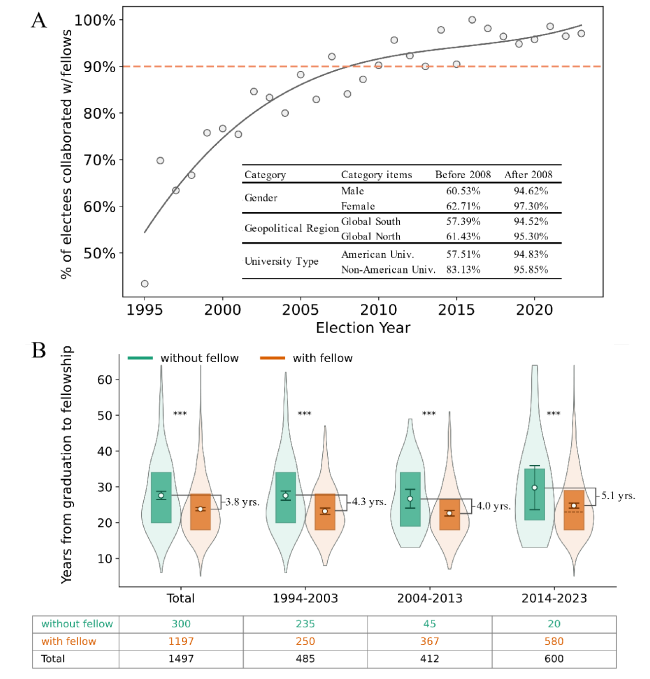
Figure 1. The increasing trend of collaborating with ACM fellows by new electees, and collaboration shortens their time to ACM fellowship. (A) Percentage of new electees who have co-authored with ACM fellows each year since 1995. Trend lines fitted to data by univariate binomial regression. Group analysis by gender, country of birth, and alma mater revealed a consistent trend across all categories. (B) The violin plot represents an overall time gap of 3.8 years from graduation to ACM fellowship between the subgroup of new electees who collaborated with fellows (orange) and the subgroup of new electees who did not collaborate with fellows (green). The results of the per-decade time grouping, on the other hand, indicate a stronger association between collaboration with ACM fellows and a shorter time to fellowship among the new electees of the last ten years (a difference of 5.1 years, ***p<0.001, up from 4.0 years, ***p<0.001, and 4.3 years, ***p<0.001, in the previous twenty- and thirty-years groups, respectively, all determined by two-sample t-tests). |
2.2 Collaboration dynamics and fellowship timing
To better understand the dynamics of collaboration and its association with the time to ACM fellowship, we employed statistical analyses, examining the relationship between various collaboration metrics and the time from graduation to the fellowship recognition of new electees (Fig. 2, see Table S1 in the Supplementary Materials for more details).
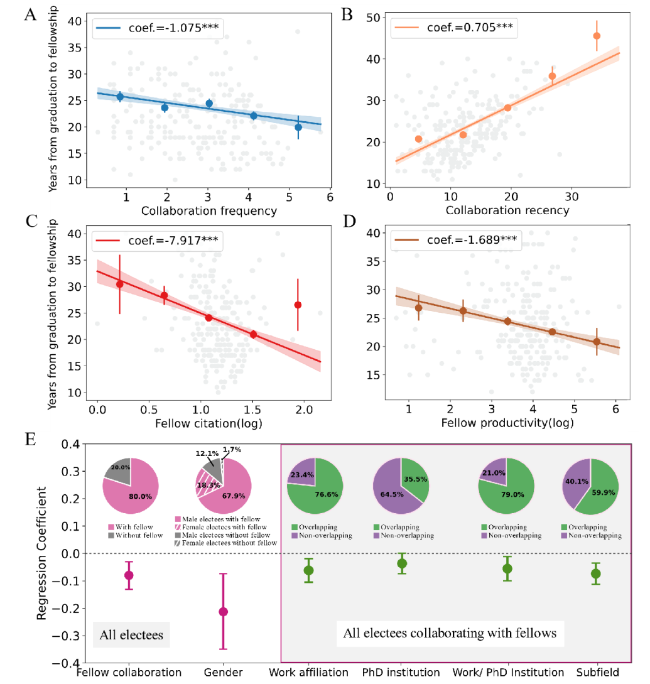


Figure 2. Results of a linear regression between fellow collaboration patterns (A, B), prestige of fellow collaborators (C, D), social factors (E), and time from graduation to ACM fellowship. The Y-axis indicates the time from graduation to ACM fellowship of new electees; the X-axis denotes (A) the number of collaboration times with ACM fellows; (B) the average year intervals from co-authorship papers published to elected; (C) the number of citations of the ACM fellow collaborators’ publications; (D) the number of publications of the ACM fellow collaborators. The data points are accompanied by error bars indicating the estimated 95% confidence intervals, and each subplot has a correlation coefficient indicating the strength of the linear relationship, with *** representing significance at the 1% level. (E) the error bar plot represents the coefficients of regressions of years from graduation to ACM fellowship. The independent variables are shown on the x-axis. All independent variables are binary. Focusing on all electees, fellow collaboration indicates whether electees have collaborated with fellows before receiving their fellowships, with “with fellow” coded as 1. Male electees are coded as 1 in gender; Among electees who have collaborated with fellows, the last four variables describe aspects of overlap with their fellow collaborators, including work affiliation, PhD institution, combined work/PhD institution, and subfield, with any overlap coded as 1. The pie charts illustrate the proportion of different categories divided by independent variables. |
1) Notably, Fig. 2A shows a significant negative regression coefficient (coefficient =-1.075, p-value<0.01) between the frequency of collaboration with ACM fellows and the time to fellowship for new electees, suggesting that frequent co-authorship with ACM fellows is correlated with a shorter journey to ACM fellowship.
2) Recency of collaboration. The analysis indicates a substantial positive coefficient (coefficient =0.705, p-value<0.01) between the timing of co-authorship with ACM fellows and the time interval to fellowship for new electees (Fig. 2B). This suggests that more recent collaborations, especially those closer to the time of a fellow’s election, are correlated with a shorter time to fellowship. Consistent with this pattern, earlier first collaborations with fellows during one’s career are associated with shorter overall pathways to fellowship (see Fig. S2 in the Supplementary Materials).
3) Prestige of collaborators. The scholarly influence of ACM fellow collaborators, as measured by citation count and productivity in the ten-year span prior to their election, was found to be significantly correlated with the advancement of new electees. Negative coefficients of -7.917 and -1.689 (both p-value<0.01), respectively, highlight the advantage of collaborating with highly cited and productive ACM fellows—those whose work has been widely recognized and cited—may provide a stronger endorsement and greater exposure for upcoming electees (Figs. 2C and 2D).
4) Social factors. Factors such as gender, work affiliation, graduate institution, and research subfield show statistical associations with the time to ACM fellowship. On average, men take less time to obtain an ACM fellowship (coefficient = -0.213, p-value<0.01). Among new electees who have collaborated with an ACM fellow, those who have overlapping workplaces with the ACM fellow (coefficient = -0.062, p-value<0.01), graduated from the same school (coefficient = -0.036, p-value<0.1), and belong to the same subfield (Laberge et al., 2022) (coefficient = -0.074, p-value<0.01) are elected more quickly (Fig. 2E).
Additionally, to address potential selection bias, we compared collaboration patterns during 2009-2018 between two groups: (1) fellows elected in 2004-2008 collaborating with earlier fellows (elected in 1996-2000), and (2) future fellows (elected in 2019-2023) collaborating with fellows elected in 2004-2008. As shown in Fig. S1, future fellows exhibited significantly higher collaboration frequencies with fellows prior to their election, suggesting that active collaboration with fellows may be a common feature of future electees. This comparison provides a baseline for understanding how collaboration dynamics differ between established fellows and emerging candidates.
Collectively, our investigation into the pathways to ACM fellowship highlights a strong correlation between collaborations, particularly with recently elected ACM fellows and those with substantial scholarly impact, and academic recognition. Our findings contribute to the growing body of literature on the significance of networking in academic careers, aligning with previous research that highlights the importance of mentorship and collaboration for scientific recognition (Sekara et al., 2018; Xing et al., 2025). Furthermore, our findings shed light on a broader principle within academia: the power of social capital—encompassing strong networks and measurable impact, as indicated by citation metrics—often rivals, and at times complements, the traditional value of intellectual capital.
3 Discussions
3.1 Addressing recognition disparities
Our findings reveal two key patterns. First, candidates who collaborate with ACM fellows are associated with fellowship recognition 3.8 years earlier on average compared to those without such collaborations, with more frequent and recent collaborations, as well as collaborators’ prestige, showing even shorter time intervals to fellowship. Second, among those who have collaborated with ACM fellows, significant disparities emerge: men tend to reach fellowship status faster than women, and candidates with shared institutional ties or academic lineage generally experience shorter times to fellowship.
These patterns, though correlational, suggest that the current nomination and endorsement processes may inadvertently favor well-connected candidates, even if this is not an explicit selection criterion. The requirement for five endorsers—often ACM fellows themselves— contributes to a nomination process where existing professional networks may influence future recognition. This dynamic is reflected in the increasing rate of co-authorship with fellows among recent electees, which has risen from 43% in 1995 to over 90% in 2023. While collaboration with established researchers remains a useful proxy for scientific influence, the increasing reliance on such networks may unintentionally disadvantage those who innovate outside traditional and established circles. This may contribute to patterns where candidates from majority demographic groups or elite institutions have greater visibility and familiarity among evaluators, potentially limiting opportunities for equally qualified peers from underrepresented communities (Novoa-Monsalve et al., 2024). Our finding that men achieve fellowship faster than women, even among those collaborating with fellows, suggests that network-based recognition processes may reflect existing disparities that extend beyond collaboration patterns alone. Existing literature has already shed light on the varied landscapes of recognition and award distribution across multiple axes, including gender, race, institutional affiliation, and geographical location (Hofstra et al., 2020; Jiang et al., 2024; Liu et al., 2023; Ma et al., 2019; Nielsen & Andersen, 2021).
Given these findings, we argue that addressing these disparities requires a re-evaluation of the nomination and selection processes. While collaboration remains an important factor in academic recognition, ensuring a balanced evaluation that considers diverse forms of contribution is essential to maintaining an inclusive and meritocratic recognition process. Potential reforms could include increasing transparency in the nomination process to better identify and address inequities in the pipeline, as well as expanding the criteria to recognize contributions beyond traditional measures, such as mentoring underrepresented groups or engaging in open-source contributions. By broadening the scope of what is valued in the recognition process, we can ensure a more inclusive approach that acknowledges diverse paths to scientific impact and fosters greater innovation across the field. This approach, while primarily focused on academia, could also have implications for other domains like practice and service, where similar network dynamics may shape recognition and opportunities for impactful work.
3.2 Limitations and future research directions
Several significant limitations must be acknowledged in interpreting our findings. As an observational study, our analysis cannot establish causality between collaboration patterns and fellowship timing, as unmeasured confounders such as inherent talent or institutional advantages may simultaneously influence both collaboration opportunities and recognition speed, making collaboration potentially a marker of preexisting advantages rather than a direct catalyst. The increasing collaboration trend may reflect broader academic networking shifts rather than fellowship-specific mechanisms, and the absence of a non-fellow control group limits our ability to distinguish ACM-specific patterns from general academic trends. Our findings regarding institutional overlaps risk conflating social proximity with academic merit, as shared affiliations may reflect systematic privileges including elite network access and evaluator biases rather than genuine research quality differences, yet our design cannot distinguish privilege amplification from merit-based collaboration benefits. Finally, ACM’s confidentiality regarding endorser identities prevents determining whether collaborating fellows directly endorse candidates or influence recognition through broader network effects, leaving underlying mechanisms unclear.
To address these limitations, future research should employ longitudinal designs tracking scientists from early career stages, quasi-experimental approaches leveraging natural collaboration experiments, and studies incorporating unsuccessful candidates control groups to isolate fellowship-specific effects from broader academic trends. Research with access to confidential nomination data could illuminate direct endorsement versus network-based pathways, while studies examining research quality independent of institutional prestige could distinguish privilege-based from merit-based explanations. Mixed-methods approaches combining quantitative analysis with qualitative investigation of collaboration quality and evaluation processes would provide deeper insights into designing recognition systems that identify genuine academic excellence while minimizing social proximity and systemic advantage influences, ultimately contributing to more equitable evaluation mechanisms.
Acknowledgments
The authors thank A. Clauset and D. Acuña for invaluable comments and suggestions.
Funding information
This work is supported by the National Social Science Foundation of China (grant No. CIA200270), National Natural Science Foundation of China (grant No. 62006109 and 12031005).
Author contributions
Fan Jiang (jiangf6@sustech.edu.cn): Conceptualization (Equal), Data curation (Equal), Formal analysis (Equal), Investigation (Equal), Resources (Equal), Writing - original draft (Equal), Writing - review & editing (Equal);
Tongxin Pan (abbyptx@gmail.com): Formal analysis (Equal), Investigation (Equal), Methodology (Equal), Software (Equal), Validation (Equal), Visualization (Equal), Writing - original draft (Equal);
Jue Wang (wangjue@ntu.edu.sg): Conceptualization (Equal), Methodology (Equal), Writing - original draft (Equal);
Yifang Ma (mayf@sustech.edu.cn): Conceptualization (Equal), Project administration (Equal), Supervision (Equal), Writing - review & editing (Equal).
Supplementary materials
This Supplementary information comprises:
1. Table. S1
2. Figure. S1
3. Figure. S2
4. Supporting Information Text
5. Supporting Information References
Access at 10.57760/sciencedb.29088